How to Make a Home Feel Calmer Without Redecorating
lifestyle
|
September 17, 2026
A home can be perfectly nice and still feel slightly wrong to be in. Not untidy exactly, not badly furnished, just somehow not restful.
The instinct is to redecorate, which is expensive and rarely the actual solution. Most of what makes a room feel calm has nothing to do with furniture or paint color.
It comes down to light, sound, surfaces, and a handful of sensory details that are easy to change and easy to overlook.
Light Does Most of the Work
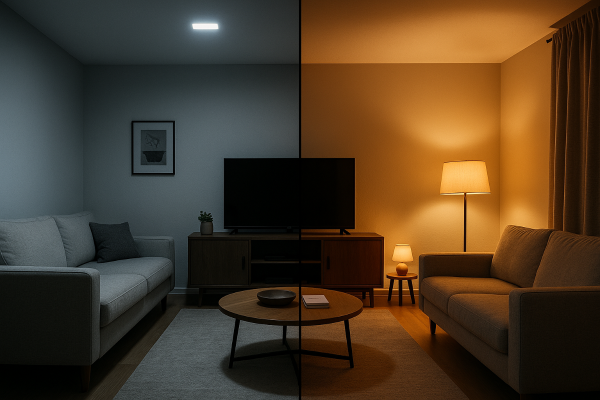
Lighting affects how a room feels more than almost anything else in it, and most homes are lit badly by default — one bright ceiling fixture doing everything.
A single overhead light flattens a room and casts hard shadows. Several smaller light sources at different heights create depth and warmth. A floor lamp, a table lamp, and something low make an enormous difference to the same room with the same furniture.
Color temperature matters too. Warm bulbs, around 2700K, read as cosy. Cool white bulbs, 4000K and above, read as clinical and are better suited to task lighting in a kitchen or bathroom. Swapping bulbs in the rooms you relax in is one of the cheapest changes available.
Dimmers, or simply using lamps rather than the ceiling light in the evening, let a room change character between day and night rather than staying at one brightness.
Clear the Horizontal Surfaces
Visual noise is the most common cause of a room feeling unsettled, and it accumulates on flat surfaces without anyone deciding it should.
Coffee tables, kitchen counters, hall tables, and the top of a chest of drawers all collect items that have no home elsewhere. The effect is cumulative and largely unnoticed until the surfaces are clear.
You do not need to declutter the whole house. Clearing the three most visible surfaces in the rooms you use most produces a disproportionate share of the benefit. Leave one or two deliberate objects rather than nothing, since entirely bare surfaces can feel austere rather than calm.
Deal With the Sound
Sound is the element people notice least and feel most. Hard floors, bare walls, and large windows create echo, which makes a room feel harsher without anyone identifying why.
Soft materials absorb sound. A rug on a hard floor, curtains rather than blinds, cushions, and a throw all reduce echo meaningfully. This is a large part of why a sparsely furnished room feels less comfortable than a layered one even when both are attractive.
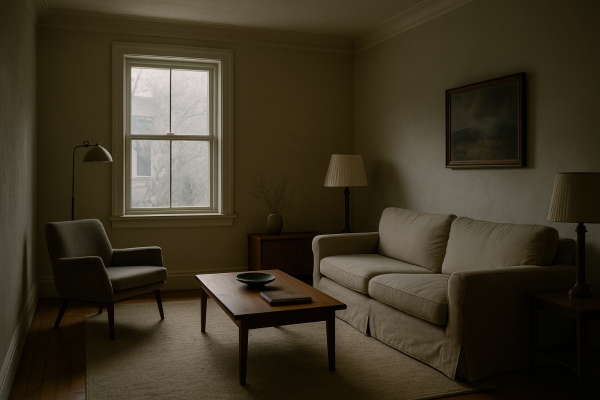
Also consider what you can hear that you have stopped noticing: a humming appliance, a ticking clock, traffic through a thin window. Some of those can be fixed, and the ones that cannot are often better masked with something pleasant than left in the background.
Add Texture Rather Than Objects
Rooms that feel cold often have plenty of things in them but very little variety of material.
Mixing textures creates warmth without adding clutter: a wool throw against a smooth sofa, a woven basket beside a painted wall, linen curtains, a ceramic bowl, a wooden board. The eye reads variation in surface as richness.
This is also why an all-neutral room can feel flat or can feel wonderfully calm depending entirely on execution. Neutral plus varied texture reads as considered. Neutral plus uniform texture reads as unfinished.
Bring in Something Living
Plants change how a room feels out of proportion to what they cost, and research on the psychological effects of indoor greenery is reasonably encouraging.
If you have killed plants before, start with genuinely durable ones — pothos, snake plant, ZZ plant, and cast iron plant all tolerate low light and irregular watering. The most common cause of houseplant death is overwatering rather than neglect.
If plants are not for you, cut branches or stems in a jug last a two weeks and cost almost nothing. Even a bowl of fruit on a kitchen table does some of the same work.
Scent, Used Lightly
Scent is powerful and the easiest of these to overdo. A room that smells strongly of anything is not restful.
The first step is removing unpleasant smells rather than covering them: ventilating, emptying bins, washing textiles. Fabric holds odour more than most people realize, so curtains, cushion covers, and throws contribute more than they seem to.
Then add something subtle if you want to. A candle, a diffuser, or simply opening a window. Keep it low and keep it consistent across a space, since several competing scents in adjacent rooms is unsettling in a way that is hard to place.
Make One Corner Work Properly
Rather than trying to improve a whole home, it is far more effective to make one small area genuinely good.
Pick a chair by a window, a corner of a bedroom, or one end of the sofa. Give it decent light, something soft, a surface to put a cup on, and nothing else competing for the space.
A single spot that reliably feels good changes how you experience the whole home more than a marginal improvement spread across every room. It also gives you somewhere to go that is not your desk or your bed, which most homes lack.
Rearranging Before Buying
Before spending anything, it is worth testing whether the layout is the actual problem, since most furniture ends up wherever it fitted on moving day.
Two questions usually reveal it. Does the seating face something worth looking at, or does it face the television by default? And is there a clear path through the room, or does everyone edge around a coffee table that is slightly too large?
Pulling furniture a few inches away from the walls often makes a room feel larger rather than smaller, which is counterintuitive and reliably true. Angling a chair toward a window, or turning a sofa to face into the room rather than at a screen, changes how a space feels without costing anything. Try it for a week before deciding it does not work.
The Entrance Sets the Tone
The first thing you see coming home affects how the whole house feels, and it is usually the least considered part of it.
Give shoes, keys, and post a defined home within arm's reach of the door, because anything without one ends up on the nearest flat surface and migrates from there into the rest of the house.
A light you can switch on immediately, a mirror, and a clear floor cover most of it. If you arrive home to a pile of shoes and a stack of unopened mail every day, that is the first thirty seconds of every evening setting a tone that the rest of the house then has to overcome.
Where to Start This Weekend
Three changes, none of which requires spending much.
Swap the bulbs in your main living space for warm ones and start using lamps rather than the ceiling light after dark. Clear the three most visible flat surfaces in your home and find homes elsewhere for what was on them. Add one soft thing to the room that echoes most.
That is an afternoon's work. If the room still feels off afterwards, the next thing to look at is usually layout rather than decoration — whether the furniture is arranged around how you actually use the room, or around where it fitted when you moved in.
Sources & References
[1] U.S. Environmental Protection Agency — Indoor air quality and ventilation guidance — https://www.epa.gov/indoor-air-quality-iaq
[2] National Institutes of Health, News in Health — Environment, wellbeing, and mental health research — https://newsinhealth.nih.gov
[3] U.S. Department of Energy — Lighting choices and energy-efficient bulbs — https://www.energy.gov/energysaver
You May Like

Building an Itinerary That Doesn't Exhaust You
September 17, 2026

The Pantry Staples That Make Weeknight Cooking Easy
September 17, 2026

Your best travel tips/travel secrets
January 23, 2023

How to plan holidays within a budget
January 23, 2023

Things to Do on Valentine's Day in Miami
January 15, 2023

MICHELIN Guide Slovenia : TaBar, when fine dining and bistro converge
December 21, 2022
Recommended Reads
The Pantry Staples That Make Weeknight Cooking Easy
September 17, 2026
2021 New York New MICHELIN Stars
January 27, 2023
EASY DINNER RECIPES FOR BEGINNERS
January 26, 2023