Staying Connected Abroad: eSIMs, Roaming, and Offline Maps
tourism
|
September 17, 2026
There was a time when getting online abroad meant hunting for a phone shop on arrival or accepting a bill that arrived three weeks later and ruined the memory of the trip.
That has changed substantially, and most travelers now have three reasonable options. Which one suits you depends on how long you are going, how much data you use, and how much you value not thinking about it.
The Three Options
Every approach is a variation on one of these.
Your home carrier's roaming, either included in your plan or as a daily or weekly add-on. Simplest by a distance, since your number keeps working and there is nothing to set up. Usually the most expensive per gigabyte, and daily-rate plans add up quickly on longer trips.
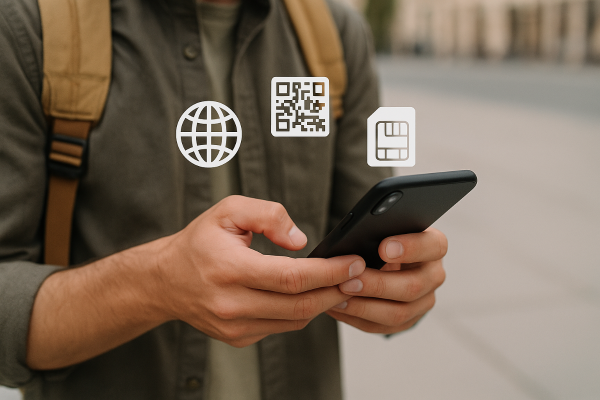
A travel eSIM, bought online before you leave and activated by scanning a code. Usually far cheaper than roaming, available immediately, and requires no physical shop. Your phone must support eSIM and must not be carrier-locked.
A local physical SIM bought at your destination. Frequently the cheapest option, particularly for longer stays, and often includes a local number. Requires a shop visit, sometimes identification, and means removing your existing SIM.
How eSIMs Actually Work
An eSIM is a digital SIM built into the phone rather than a card you insert. You buy a data plan online, receive a QR code, scan it, and the plan installs.
The practical advantage is that your regular SIM stays active alongside it. Calls and texts to your usual number still arrive, while data runs over the travel plan. That dual capability is what makes eSIMs the default choice for most short trips now.
Two things to check before buying. First, that your phone supports eSIM — most flagship models from the last several years do, but plenty of mid-range and older phones do not. Second, that your phone is carrier-unlocked, since locked phones often cannot install a third-party eSIM.
Install and set up the eSIM before you fly, while you still have reliable wifi. Activation usually needs a connection, which is awkward to arrange at an airport in a country where you have no data.
Choosing Between Them
A rough guide based on trip length and usage.

- A weekend, light usage: your carrier's roaming add-on is probably fine, and the simplicity is worth the premium.
- One to three weeks: a travel eSIM is usually the best balance of cost and convenience.
- A month or more in one country: a local physical SIM will almost certainly be cheapest, and the shop visit amortizes over the stay.
- Multiple countries in one trip: a regional eSIM covering the whole area avoids buying something new at each border.
- Heavy data use, such as working remotely: compare carefully, since eSIM plans with large allowances can cost more than a local SIM.
Before You Leave: The Offline Setup
Whatever connectivity you arrange, assume at some point you will have none. The setup below takes twenty minutes and removes most of the problems that causes.
Download offline maps for your destination. Both major mapping apps support this, and offline maps include search and walking directions without a signal. Download a wider area than you think you need, since the useful moment is usually when you are somewhere unexpected.
Download an offline translation pack for the local language, including camera translation if available. Download any tickets, boarding passes, and booking confirmations rather than relying on links in emails. Screenshot your accommodation address, ideally in the local language as well as your own.
And note that a hotel address written in the local script is far more useful to a taxi driver than one written in English, even if you can pronounce it.
Avoiding an Unexpected Bill
Roaming charges outside a plan can be startling, and the protections are worth knowing.
Before you travel, check exactly what your plan includes and in which countries. Turn off data roaming in your phone settings if you are relying on an eSIM or local SIM, so the phone cannot quietly fall back to your home carrier.
Set a data limit or spending cap with your carrier if they offer one. Turn off automatic app updates and background app refresh, both of which consume data invisibly. And be careful near borders and on ferries, where phones sometimes connect to a network in the neighbouring country without any obvious sign.
Using Public Wifi Sensibly
Free wifi in cafés, airports, and hotels is convenient and worth using with a little care.
Avoid logging into banking or entering payment details on an open network. If you need to do either, use your mobile data instead, which is considerably harder to intercept. Many travelers use a VPN on public networks, which encrypts traffic and is a reasonable precaution.
Turn off automatic connection to open networks, so your phone is not silently joining unknown ones as you walk around. And be wary of networks with names very similar to a legitimate one nearby, which is a common way of harvesting credentials in airports.
Backups Worth Having
Two low-effort precautions cover the failure cases.
Keep a printed copy of your accommodation address, your first day's plan, and any critical booking references. Paper works when a phone is lost, stolen, or dead, and the moment you need it is exactly the moment your phone is unavailable.
Carry a power bank. Navigation, translation, tickets, and payment all running through one device means battery is a single point of failure for the entire trip. And remember that power banks must go in cabin baggage rather than checked luggage.
If Something Goes Wrong
Knowing what to do when connectivity fails matters more than the plan you chose, since it will fail at some point.
If an eSIM will not activate, check that data roaming is enabled for that specific line, that the correct line is selected for data, and that airplane mode is fully off. Most activation failures are settings rather than faults, and the provider's support is usually reachable over wifi.
If your phone is lost or stolen, having your accommodation address and key numbers on paper is what turns a crisis into an inconvenience. Know how to remotely wipe your device, and keep a note of your passport number somewhere other than the phone.
Public wifi at an airport, café, or public library is the fallback for almost everything, which is another reason to have your essential information downloaded rather than living behind a login.
A Simple Plan for Most Trips
Buy a travel eSIM a few days before you fly and install it at home. Download offline maps and a translation pack. Screenshot your accommodation details. Turn off data roaming so nothing falls back to your carrier.
That covers the overwhelming majority of trips for a fraction of roaming costs, and it means you arrive already connected rather than standing in an arrivals hall trying to find wifi.
Sources & References
[1] U.S. Department of State — Traveler's checklist and staying connected abroad — https://travel.state.gov
[2] Federal Communications Commission — International roaming and mobile service information — https://www.fcc.gov
[3] Cybersecurity and Infrastructure Security Agency — Public wifi and travel cybersecurity guidance — https://www.cisa.gov
You May Like

The Pantry Staples That Make Weeknight Cooking Easy
September 17, 2026

Keto Chicken Salad
February 10, 2023

Advice For Travelling With Children
January 24, 2023

Challenges Immigrants and Refugees Face in the US
January 10, 2023

Which markets have fallen or suffer the risk of falling due to the conflict
December 15, 2022

How will a prolonged Russia-Ukraine conflict affect your investment portfolio?
December 12, 2022
Recommended Reads

How Adaptogen Teas Like Ashwagandha Can Support Your Health
June 28, 2026
Advice For Travelling With Children
January 24, 2023
Date Ideas for Valentine's Day in 2022 That You Wouldn't Expect
December 19, 2022