When Dinner Goes Wrong: Fixes for Too Salty, Bland, Burnt, and Overcooked
deliciousfood
|
September 17, 2026
You taste the sauce and it is aggressively salty. Or it tastes of nothing at all. Or there is a smell coming from the bottom of the pan that means something has caught.
Most of these are recoverable, and the fix usually takes under five minutes. The main thing standing between a rescued dinner and an ordered one is knowing which lever to pull.
Too Salty
This is the most common and the most rescuable, provided you have not reduced the dish to almost nothing.
Dilution is the most reliable answer. Add more of the unsalted components — more stock, water, canned tomatoes, cream, rice, or vegetables. The saltiness is a ratio, and increasing the volume changes the ratio.
Acid helps distract the palate from salt. A squeeze of lemon or a splash of vinegar will not remove salt but genuinely makes a dish taste less salty. A little sweetness does something similar, and a dairy element such as cream, yoghurt, or a knob of butter softens the edge.
The old advice about dropping in a raw potato to absorb salt does not really work. The potato absorbs salty liquid rather than salt specifically, so it is a slow and inefficient version of dilution. Adding more liquid does the same thing faster.
Too Bland
Blandness is usually diagnosed as needing more salt, and salt is often only part of the answer.
Work through four things in order. Salt first, in small increments, tasting as you go. Then acid, which is the element most often missing in home cooking — lemon juice or vinegar lifts everything and makes flavors distinct rather than muddy.
Then fat, because a knob of butter or a drizzle of good oil carries flavor and gives it body. Then a savory depth booster: soy sauce, fish sauce, tomato purée, mustard, a stock cube, or an anchovy melted in. Any of those adds the background richness that separates a thin dish from a full one.
Too Spicy
Capsaicin is fat-soluble, which is the key to fixing this and the reason water does nothing.
Dairy is the most effective intervention. Cream, yoghurt, coconut milk, sour cream, or cheese will genuinely reduce perceived heat rather than just masking it. A fat such as butter or oil helps for the same reason.
Beyond that, dilute with more of the base ingredients, add something sweet, or add something acidic. Serving with plain rice, bread, or potato also works, since it gives the palate somewhere to retreat between mouthfuls.
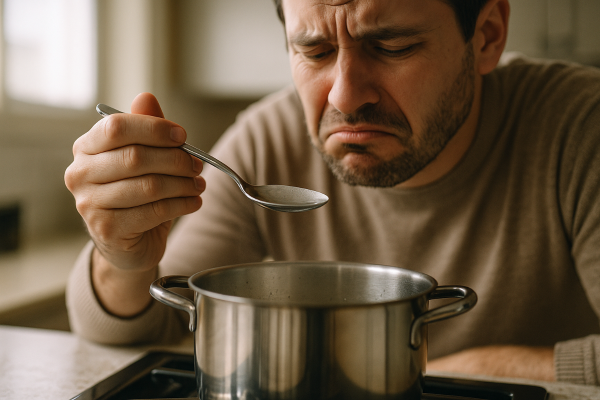
Burnt on the Bottom
Speed matters here more than anywhere else, because the burnt flavor keeps transferring for as long as the food sits in contact with the pan.
Immediately transfer the unburnt food into a clean pan. Do not scrape the bottom, which is precisely how the burnt flavor spreads into the rest. Take what lifts easily and leave the rest behind.
Taste what you rescued. If there is a mild burnt note, a little sweetness, acid, or a strong flavoring such as smoked paprika or tomato purée can cover it. If the burnt taste is pronounced, it will not be masked, and continuing to work on it usually wastes more ingredients.
Overcooked and Dry
Overcooked meat cannot be un-cooked, but it can be made pleasant to eat.
The most effective approach is to change the format. Slice dry chicken or pork thinly against the grain and serve it with a generous sauce, or shred it entirely and fold it through something wet — a curry, a stew, a pasta sauce, a filling for wraps. Shredded and sauced, overcooked meat is genuinely good rather than merely edible.
Overcooked vegetables blend well into soup. Overcooked pasta is beyond rescue as pasta, but it works in a baked dish where softness is expected.
Split, Lumpy, or Thin Sauces
Sauce problems look dramatic and are usually straightforward.
A split or separated sauce can often be brought back by removing it from the heat and whisking in a small amount of cold liquid, or by starting again with a spoonful of the base in a clean pan and whisking the split sauce into it gradually.
Lumps come out with a whisk, a stick blender, or a sieve. For a sauce that is too thin, reduce it over heat, or stir in a slurry of cornflour mixed with cold water — never dry cornflour straight into hot liquid, which is how lumps form in the first place. For a sauce that is too thick, add liquid gradually.
Undercooked, Discovered Late
This is the one case where the answer is simply to keep cooking, and it is worth being firm about.
Undercooked poultry, mince, pork, and eggs are a genuine food safety matter rather than a texture preference. Return the food to the heat and cook it through — poultry and leftovers to 165°F, ground meats to 160°F, whole cuts of beef and pork to 145°F with a rest.
A food thermometer removes the guesswork entirely and is the single cheapest upgrade available to a home kitchen. Judging by color is unreliable, particularly with poultry and mince.
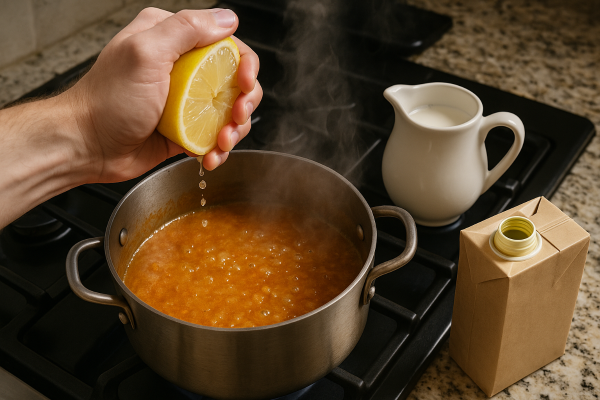
Baking Problems Are Different
Everything above applies to savory cooking, where you can taste and adjust. Baking is chemistry with a fixed outcome, and the fixes are narrower.
A cake that sank in the middle is usually underbaked, or the oven door was opened too early. It cannot be un-sunk, but the middle can be cut out and the result served as a ring, or the whole thing broken up into a trifle or a crumb base.
Biscuits that spread too much usually had butter that was too soft or dough that was not chilled. Bread that did not rise is usually dead yeast or a liquid that was too hot when it was added. None of these is rescuable mid-bake, which is why baking rewards measuring and cooking rewards tasting.
Repurposing Rather Than Rescuing
Sometimes the honest answer is that the dish is not going to be what you intended, and the useful move is deciding what else it could be.
An overreduced, too-intense sauce becomes a condiment rather than a sauce — a spoonful alongside something plain instead of a coating. A stew that went wrong texturally often blends into a perfectly good soup. Vegetables roasted past the point of elegance become the base of a purée or a dip.
Approaching it this way tends to produce something genuinely worth eating, whereas continuing to correct a dish that has gone too far usually consumes more ingredients and arrives somewhere worse.
How to Avoid Most of This
Two habits prevent the majority of these situations.
Taste as you cook, not at the end. Salt in small amounts at several stages rather than all at once, because you can always add and you cannot remove. Most oversalting happens when someone seasons a dish once, heavily, at the start.
And keep the heat lower than feels efficient when something is simmering unattended. Almost everything that catches on the bottom of a pan does so because it was on a higher heat than it needed, in a pan thinner than the job required, without a stir.
Sources & References
[1] USDA Food Safety and Inspection Service — Safe minimum internal cooking temperatures — https://www.fsis.usda.gov/food-safety
[2] FoodSafety.gov — Safe cooking temperature charts — https://www.foodsafety.gov
[3] U.S. Food and Drug Administration — Safe food preparation guidance — https://www.fda.gov/food
You May Like

The Travel Documents People Forget Until It's Too Late
September 17, 2026

Banana Bread
February 16, 2023

Advice for traveling with children
January 25, 2023

Most Expensive Valentine's Day Destinations in the World
December 30, 2022

CAN A BIT OF OREOS GIVE YOUR MISSISSIPPI MUD PIE AN EXTRA KICK?
December 27, 2022

This Year's Most Popular Airbnb Destinations for Valentine's Day
December 18, 2022
Recommended Reads
The Travel Documents People Forget Until It's Too Late
September 17, 2026
Staying Connected Abroad: eSIMs, Roaming, and Offline Maps
September 17, 2026
2021 New York New MICHELIN Stars
January 27, 2023