Cooking Oils: Which One for Which Job
deliciousfood
|
September 17, 2026
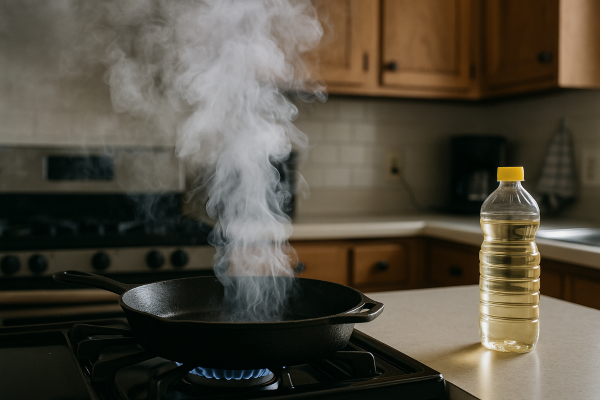
Most kitchens have one bottle of oil doing every job, and most of the time that works well enough. It stops working the moment the pan gets properly hot and the kitchen fills with smoke.
Oils differ in two ways that matter for cooking: how much heat they tolerate before breaking down, and how much flavor they bring. Matching those to the job is most of what there is to know.
What a Smoke Point Actually Is
The smoke point is the temperature at which an oil begins to break down and visibly smoke. Past it, the oil degrades, develops a harsh burnt flavor, and releases unpleasant compounds into the air.
This is the practical reason to care. An oil pushed past its smoke point makes food taste bitter and fills the kitchen with smoke. It is not a subtle effect — you will know.
Refining raises smoke point. That is why refined and light olive oil tolerates far more heat than extra virgin, even though both come from olives. Refining strips out the compounds that burn, which also strips out much of the flavor.
High-Heat Oils
For searing, stir-frying, deep-frying, and anything above roughly 400°F, you want an oil that stays stable.
- Refined avocado oil, around 520°F. The highest commonly available smoke point, neutral in flavor, and expensive.
- Refined safflower and rice bran oil, roughly 490 to 510°F. Neutral and well suited to frying.
- Ghee or clarified butter, around 485°F. Butter with the milk solids removed, which is what allows the high heat while keeping a buttery flavor.
- Light or refined olive oil, around 465°F. A good general high-heat option that is widely available.
- Refined peanut oil, around 450°F. A traditional frying oil with a mild flavor.
- Refined canola and sunflower oil, roughly 400 to 450°F. Inexpensive, neutral, and perfectly good for most high-heat cooking.
Medium-Heat and Everyday Oils
Most home cooking happens well below frying temperatures, which is where these belong.
Extra virgin olive oil sits somewhere around 350 to 410°F depending on quality and freshness. That is entirely adequate for sautéing, roasting at moderate temperatures, and most pan cooking. The idea that it cannot be cooked with at all is overstated — it simply is not a deep-frying oil.
Butter smokes around 300 to 350°F because of its milk solids, which is why it browns and then burns quickly. Adding a little neutral oil to the pan alongside butter raises the effective smoke point while keeping the flavor, which is why so many recipes call for both.
Virgin coconut oil sits around 350°F and brings a distinct coconut flavor that suits some dishes and intrudes on others.
Finishing Oils, Not Cooking Oils
Some oils are bought for flavor and should never see real heat.
Toasted sesame oil is a seasoning rather than a cooking medium. Added at the end of a stir-fry it is excellent; used to fry in, it turns bitter almost immediately. A good extra virgin olive oil is at its best drizzled raw over finished food, where its flavor survives.
Walnut, flaxseed, and pumpkin seed oils are delicate, expensive, and go rancid quickly. Keep them in the fridge, use them cold, and buy small bottles.
Which Oil for Which Job
A short practical mapping covers most cooking.
Searing steak or getting a hard crust on anything: a neutral high-smoke-point oil. Deep frying: refined peanut, canola, or sunflower. Stir-frying: a neutral high-heat oil, with sesame added at the end for flavor.
Roasting vegetables at 400°F or below: olive oil. Sautéing onions and garlic: olive oil or butter. Salad dressing: extra virgin olive oil or a nut oil. Baking: usually a neutral oil or melted butter, depending on whether you want the flavor.
Storing Oil Properly
Oil goes rancid through exposure to light, heat, and air, and rancid oil tastes stale and slightly bitter in a way that is easy to miss until you compare it with a fresh bottle.
This means the bottle kept beside the stove for convenience is in the worst possible place. Store oil in a cool, dark cupboard instead. Keep the cap on properly, since air is one of the three culprits.
Buy sizes you will finish within a few months rather than the large economy bottle, unless you cook often enough to use it. Dark glass or cans protect better than clear plastic. Delicate nut and seed oils belong in the refrigerator.
Reusing Frying Oil
Oil used for deep frying can be reused, within limits, and there is no need to discard a large quantity after one use.
Let it cool completely, then strain it through a fine sieve or cheesecloth to remove food particles, which burn and accelerate breakdown. Store it in a sealed container somewhere dark.
Discard it once it darkens noticeably, smells off, foams on heating, or smokes at a lower temperature than it used to. Oil used for strongly flavored food, particularly fish, carries that flavor into whatever you fry next.
Never pour used oil down the sink. It solidifies and blocks drains. Let it cool, seal it in a container, and dispose of it with household waste or at a local collection point if one exists.
Reading the Label
Oil labeling is inconsistent and a few terms are worth decoding before you buy.
Extra virgin means the oil was extracted mechanically without heat or chemicals, which preserves flavor and the compounds that give it character. Virgin is a similar process at a slightly lower grade. Refined, light, or pure indicates processing that raises the smoke point and strips flavor — light refers to color and taste, not calories, which catches people out.
Vegetable oil is a generic term that may be a blend of several oils, and the composition can change between batches. It is inexpensive and neutral, which is fine for frying, but you will not know exactly what you are buying.
Cold pressed indicates extraction kept below a certain temperature. It generally means more flavor and a lower smoke point, which points toward finishing rather than cooking.
How to Tell If Oil Has Gone Off
Rancid oil is unpleasant rather than dangerous, and most people have eaten it without noticing because the change happens gradually.
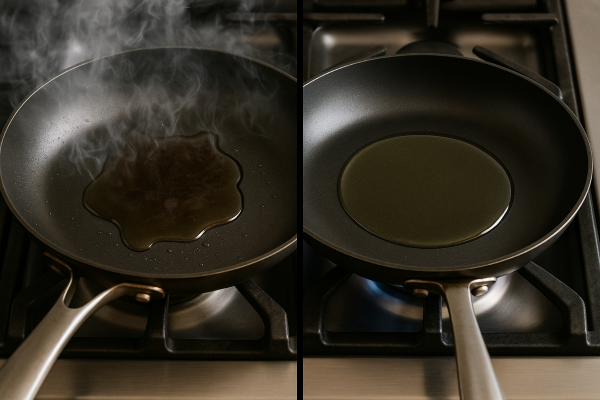
The signs are a smell like crayons, putty, or old nuts, a bitter or metallic aftertaste, and a darker color than the oil had when it was opened. A useful check is to pour a little into a spoon and smell it directly rather than sniffing the bottle neck.
If you suspect a bottle has turned, compare it against a fresh one. The difference is usually obvious side by side and almost invisible on its own, which is exactly why rancid oil stays in kitchens for months.
Two Bottles Is Usually Enough
Most kitchens do not need six oils. A neutral oil with a high smoke point for anything hot, and a decent extra virgin olive oil for everything else and for finishing, covers the overwhelming majority of home cooking.
Add a third only when you cook something that genuinely calls for it. If your smoke alarm goes off regularly when you sear, the neutral bottle is the one to buy first.
Sources & References
[1] U.S. Food and Drug Administration — Fats and oils labeling and food safety — https://www.fda.gov/food
[2] U.S. Department of Agriculture — Dietary guidance on fats and oils — https://www.myplate.gov
[3] National Institutes of Health, Office of Dietary Supplements — Dietary fats and nutrition information — https://ods.od.nih.gov
You May Like

Staying Connected Abroad: eSIMs, Roaming, and Offline Maps
September 17, 2026
2022 Chicago New MICHELIN Stars
January 28, 2023

Self-Care According to Your Cycle
January 26, 2023

How To Plan A Vacation On A Budget
January 24, 2023

The Conflict between Russia and Ukraine Explained
January 10, 2023

CAN A BIT OF OREOS GIVE YOUR MISSISSIPPI MUD PIE AN EXTRA KICK?
December 27, 2022
Recommended Reads

Tips for Planning a Round-The-World Trip
January 19, 2023
Events Leading To 2022 Russian Invasion of Ukraine
January 9, 2023
Travelling as an Adult With Family? Here’s How to Stay Sane
December 31, 2022